
When Is the Right Age And Time for Knee Replacement Surgery in Jaipur? (Avoid Permanent Joint Damage)
Updated: 1 day ago
Living with knee pain changes everything. Everyday joys like walking in the garden, visiting religious places, attending family weddings, or simply getting out of bed without groaning slowly fade away.
Almost every patient who visits Dr. Neeraj Choudhary at Indus Jaipur Hospital asks one critical question:
“Doctor, my knees hurt, but should I wait until I can no longer walk at all before getting surgery?”
The short answer is No. Waiting until you are completely disabled is the biggest mistake you can make for your joints.
Here is a clear, doctor-verified guide on knowing when the time is truly right for a knee replacement, how modern muscle-sparing techniques allow you to walk within 24 hours, and why delaying surgery causes irreversible harm.
Normal Knee Aging vs. Severe Arthritis: When Do You Truly Need Surgery?
Daily Activity & Symptoms | Normal Knee Aging (Wait & Watch) | Severe Arthritis (Time for Surgery) |
Walking Ability | Thoda chalne par thakan ya dard hota hai; daily kaam aaram se chalte hain. | 100–200 meter chalna bhi mushkil; bina sahare chalna dardnak. |
Night Pain / Sleep | Raat ko aaram se so paate hain; rest karne par dard kam hota hai. | Raat ko sote waqt dard se neend toot jaati hai (Rest Pain). |
Leg Alignment (Shape) | Dono pair bilkul seedhe rehte hain. | Pair andar ki taraf mudne lagte hain (Bow Legs / Varus). |
Effect of Medicines | Painkiller ya exercise se foran lamba aaram mil jata hai. | Painkillers aur joint injections asar karna band kar chuke hain. |
Stairs & Sitting | Seedhi chadhte waqt thoda zor padta hai par khud kar lete hain. | Seedhi chadhna aur kursi/bed se uthna bina support ke namumkin. |
Clinical Decision | Physiotherapy, weight control, healthy lifestyle. | Timely Knee Replacement Consultation (Haddiyan bachane ke liye). |
4 Clear Signs That It Is Time for Knee Replacement Surgery
Knee replacement is never the first option. For mild to moderate arthritis, exercises, lifestyle changes, and medications help. However, when osteoarthritis advances to Grade 3 or Grade 4, waiting further only damages your bones and weakens your muscles.
You should seriously consider a consultation if you have:
1. Pain That Destroys Your Night Sleep (Rest Pain)
In early arthritis, knees hurt only after walking or climbing stairs. When the protective joint cartilage completely wears away, raw bone rubs against bone. If you have a constant dull, throbbing ache that wakes you up at night or hurts even while sitting, conservative medicines will no longer fix it.
2. Difficulty Walking Even 100 to 200 Meters
When simple tasks like grocery shopping, going to the bathroom, or climbing just 4–5 stairs feel like a mountain to climb, your quality of life is compromised. If knee stiffness forces you to depend on family members for daily chores, surgery restores your independence.
3. Visible Inward Bending of Legs (Bow Legs / Varus Deformity)
Look at your knees in the mirror. If your lower legs are visibly bending inward like a bow, the inner joint compartment has completely collapsed. Delaying surgery at this stage causes severe ligament tightening and bone erosion.
4. Medicines and Injections Have Stopped Working
If painkiller tablets, knee braces, and joint injections (PRP or hyaluronic acid) only provide temporary relief for a few days, your cartilage cannot regenerate. Continuing heavy painkillers for months carries severe risks of permanent kidney failure and stomach ulcers.
What Happens If You Delay Knee Replacement Too Long?
Many patients delay surgery out of fear, hoping the pain will magically vanish. Unfortunately, advanced arthritis is a progressive wear-and-tear condition. Waiting too long creates serious clinical complications:
Severe Bone Loss: Continuous bone friction grinds away natural bone stock, making future surgery more complex.
Rigid Ligament Deformity: The surrounding ligaments contract, making complete knee straightening difficult.
Severe Muscle Weakness (Atrophy): Because you avoid walking due to pain, thigh and calf muscles waste away. Stronger pre-surgery muscles mean much faster post-surgery recovery.
Damage to Hips and Spine: Walking with an uneven gait places unnatural stress on your other knee, hip joints, and lower back, creating secondary chronic pain.
Why Patients Across Rajasthan Trust Dr. Neeraj Choudhary for Knee Joint Replacement
When planning joint surgery, surgical precision and personalized care determine your long-term outcome.
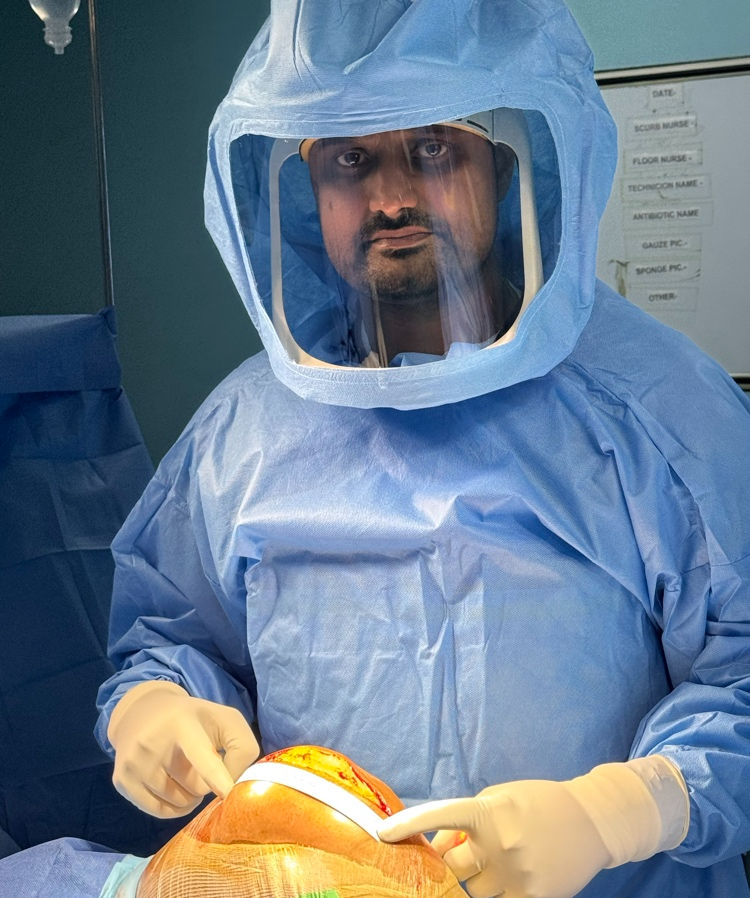
Muscle-Sparing Surgical Precision: Natural muscles and tendons are gently separated rather than cut, ensuring minimal tissue trauma and reduced blood loss.
Early Mobilization Within 24 Hours: With modern multi-modal pain protocols, our patients stand and take their first guided steps within hours of surgery.
Zero Guesswork with Digital Alignment: Pre-operative digital planning ensures perfect anatomical limb alignment, eliminating bow-leg deformities and ensuring implants last 25–30+ years.
Comprehensive Care at Indus Jaipur Hospital: Complete in-hospital infrastructure, specialized joint care nursing, dedicated physiotherapy, and clean modular joint replacement operation theaters.
Local Outreach OPDs Across Rajasthan: Post-surgery follow-up care is made seamless with monthly outreach consultation clinics in Sri Ganganagar, Bikaner, Hanumangarh, Agra, Alwar, and Merta City.
Quality joint replacement care should be accessible without financial stress. At Indus Jaipur Hospital, planned knee and hip surgeries are covered under:
RGHS (Rajasthan Government Health Scheme) – Cashless for state employees and pensioners
Ayushman Bharat / MAAY (Mukhya Mantri Ayushman Arogya Yojana)
CGHS / ECHS
All Major Private Health Insurance TPAs (Star Health, HDFC ERGO, ICICI Lombard, Care, Bajaj Allianz, and more)
Frequently Asked Questions (FAQs) – Quick Clinical Answers
Q1. What is the ideal age for knee replacement surgery?
There is no "fixed" age. Joint surgery is recommended based on joint damage and physical disability, not age. Patients in their 50s suffering from severe premature arthritis benefit just as much as active individuals in their 70s and 80s who wish to live without pain.
Q2. How long does recovery take? When can I return to normal routine?
Patients start walking with support within 24 hours. Independent walking, climbing stairs, and indoor mobility are achieved before hospital discharge (usually 3–4 days). Most patients resume driving and normal routine activities within 3 to 4 weeks.
Q3. Will an artificial knee last for my lifetime?
Yes. Modern implants crafted from advanced medical-grade alloys (Cobalt-Chromium / Oxidized Zirconium) and highly cross-linked polyethylene inserts are engineered to last 25 to 30+ years when placed with accurate anatomical balance.
Q4. Can I get a second opinion before deciding on surgery?
Yes. You can consult with your recent standing digital weight-bearing X-rays to get an honest clinical assessment of whether surgery is genuinely necessary or if conservative care can still help.
Q5. Is Knee Replacement Safe for Diabetic, BP, or Cardiac Patients?
Ans: Haan, bilkul safe hai. Indus Jaipur Hospital mein hum surgery se pehle comprehensive pre-anesthetic checkup (PAC), cardiac clearance aur blood sugar strict control protocols follow karte hain. Hamare clean laminar-flow joint replacement modular theaters post-surgery infection risk ko zero tak le aate hain.
Q6. What Is the Success Rate and Lifespan of Knee Replacement Implants?
Ans: Modern knee replacement surgery ka clinical success rate 98% se zyada hai. Advanced Cobalt-Chromium aur Oxidized Zirconium implants with highly cross-linked polyethylene components anatomically align hone par 25 se 30+ saal tak smoothly kaam karte hain.
Q7. How Soon Can I Walk and Climb Stairs After Surgery?
Ans: Modern muscle-sparing technique aur multimodal pain-management protocols ki wajah se patients surgery ke 24 ghante ke andar physiotherapist ke support se chalna shuru kar dete hain. Hospital se discharge hone se pehle (3-4 din mein) corridor walk aur seedhi chadhna sikhaya jata hai.
Take the First Step Toward Pain-Free Walking Today
Do not let knee pain dictate your lifestyle or force you into isolation. Timely evaluation protects your bones and ensures a quick, smooth recovery.
Consultation: Dr. Neeraj Choudhary (MS Orthopaedics, Joint Replacement Specialist)
Hospital: Indus Jaipur Hospital, Mansarovar, Jaipur
OPD Helpline / WhatsApp: +91 9887625678
Book Online / Learn More: https://www.drneerajchoudhary.com/knee-replacement-jaipur



Comments